


First Team Fury vs. Thunder vs. Storm: Which Portable Basketball Goal Should You Buy?
The right commercial portable basketball goal starts with how people will play around it. Shooting practice and full games put different demands on the space beneath the basket. When players drive, rebound and move along the baseline, the position of the support becomes a major buying consideration.
At Quality Hoops, our starting question is simple: will this system mainly serve training sessions, or will players be competing underneath it? That answer helps determine how much overhang your facility should prioritize.
Fury and Thunder each provide 48 inches of extension at a 10-foot rim height. Storm offers an adjustable 54–66 inches. These commercial systems also differ in backboard options, adjustment mechanisms and warranty coverage.
Fury, Thunder and Storm at a Glance
On a phone, swipe across the table to compare all columns.
| Model | Published extension | Height adjustment | Main comparison point |
|---|---|---|---|
| Fury | 48 inches at a 10-foot rim height | Hand crank; 6 feet 6 inches to 10 feet | Backboards up to 60 inches wide; Lifetime Limited Warranty |
| Thunder | 48 inches at a 10-foot rim height | Hand crank; 6 feet 6 inches to 10 feet | Backboard options up to 72 inches; Lifetime Superior Warranty |
| Storm | Adjustable from 54 to 66 inches | Spring-assisted pin adjustment; 6 to 10 feet | Longer reach; padding around the front, sides and back of the base |
Extension measurements follow First Team's published descriptions. Confirm the selected system's drawing and playing-height configuration when planning its position.
Why Overhang Matters During Games
Overhang describes how far the backboard projects from the support or base, using the manufacturer's specified measurement points. Longer reach can allow the base to sit farther behind the backboard while the basket stays in its intended court position.
We emphasize this distinction when a facility moves from shooting drills to actual games. Players gathering underneath the rim need room to move without the equipment occupying the same space. A support that feels unobtrusive during stationary shooting may become much more noticeable during rebounds and drives.
Storm's additional reach is worth evaluating for those situations. It does not eliminate contact risk: the complete layout, required ballast, padding and proper setup still matter. Our basketball hoop overhang guide explains the measurement in more detail.
When to Compare Fury and Thunder
Fury and Thunder share the same published 48-inch extension at regulation rim height. Moving from Fury to Thunder therefore does not buy additional overhang.
Instead, compare the package you need. Fury's backboard selection tops out at 60 inches wide. Thunder offers configurations up to 72 inches and carries a different warranty tier. Those distinctions can matter to a facility even when the available reach is unchanged.
Start with the intended activities and court layout, then compare the board, rim and warranty for the exact package. A model name alone does not describe every component included.
When Storm's Longer Reach Deserves Priority
If your facility expects games with frequent play beneath the basket, compare Storm early in the buying process. Its 54–66-inch extension gives you more flexibility to place the base farther behind the playing area than the 48-inch alternatives.
The practical question is whether your planned layout provides enough separation between players and the equipment. Give that decision priority before choosing a backboard material or padding color.
Storm also uses a different height-adjustment mechanism, so compare how staff will set it up and move it. Additional reach needs to work with your available floor space and storage route.
Buying for Tournament Play
For a tournament purchase, confirm the organizer's current equipment and court requirements before choosing a package. Check the specified support clearance, backboard, rim and padding together.
A four-foot overhang measurement alone does not establish that a complete system qualifies for a particular tournament. Tell Quality Hoops which organization or ruleset governs your event so the proposed equipment can be checked against those requirements.
Measure the Doorway and the Entire Storage Route
We advise facility buyers to plan around double-door access rather than assume these commercial units will pass through a typical single doorway. Lowering or folding a system addresses height clearance; it does not automatically solve width clearance.
Measure the clear opening with doors open, including any fixed center post. Check turns, thresholds and the storage area, then compare those measurements with the selected model's transport drawing. Thunder's manufacturer description specifically identifies standard-height double-door clearance with its extension arm lowered. Verify Fury and Storm against their own drawings and transport instructions.
Are These Too Much for a Home Court?
These commercial systems can be considered for a residential project, but we regard them as larger than the average homeowner needs. The right answer depends on the intensity of play, available space and how the goal will move and store.
For a typical driveway, begin with our broader portable basketball goal selection. For a dedicated home court intended for games, share the layout before deciding whether commercial equipment is appropriate.
Get Help Comparing the Right Configuration
Contact Quality Hoops with your court dimensions, intended activities, doorway measurements and any tournament requirements. We can help compare Fury, Thunder and Storm around the space players need beneath the basket and the configuration your facility actually requires.
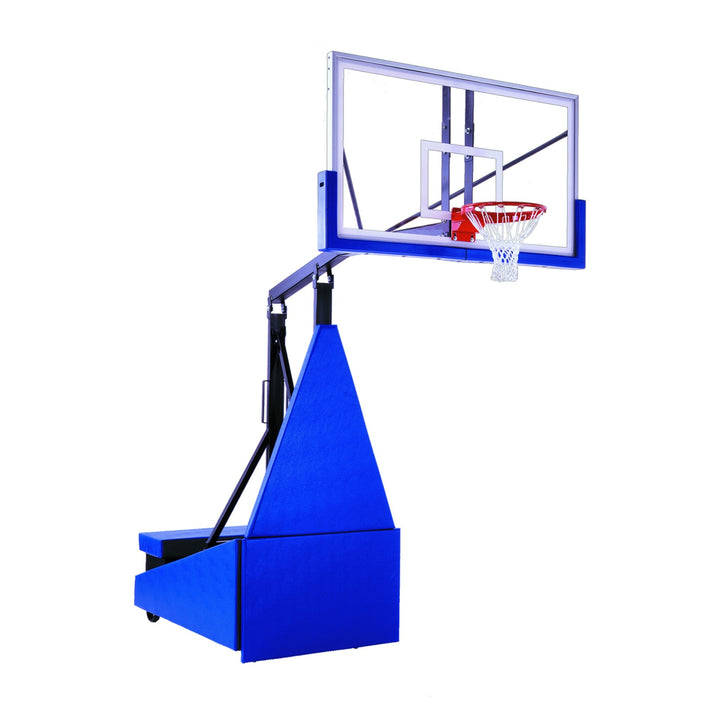
Buying guidance from Daniel Cox, Quality Hoops. Specifications checked October 18, 2026 against First Team's Fury, Thunder and Storm product information. Featured image is a manufacturer catalog image of Storm, not a photograph of a specific facility installation.


Leave a comment